TERRARIUM
Terrarium is a 3D planet where you change the physics by voice and one jelly blob uses reinforcement learning to evolve a new body and brain.
what they built
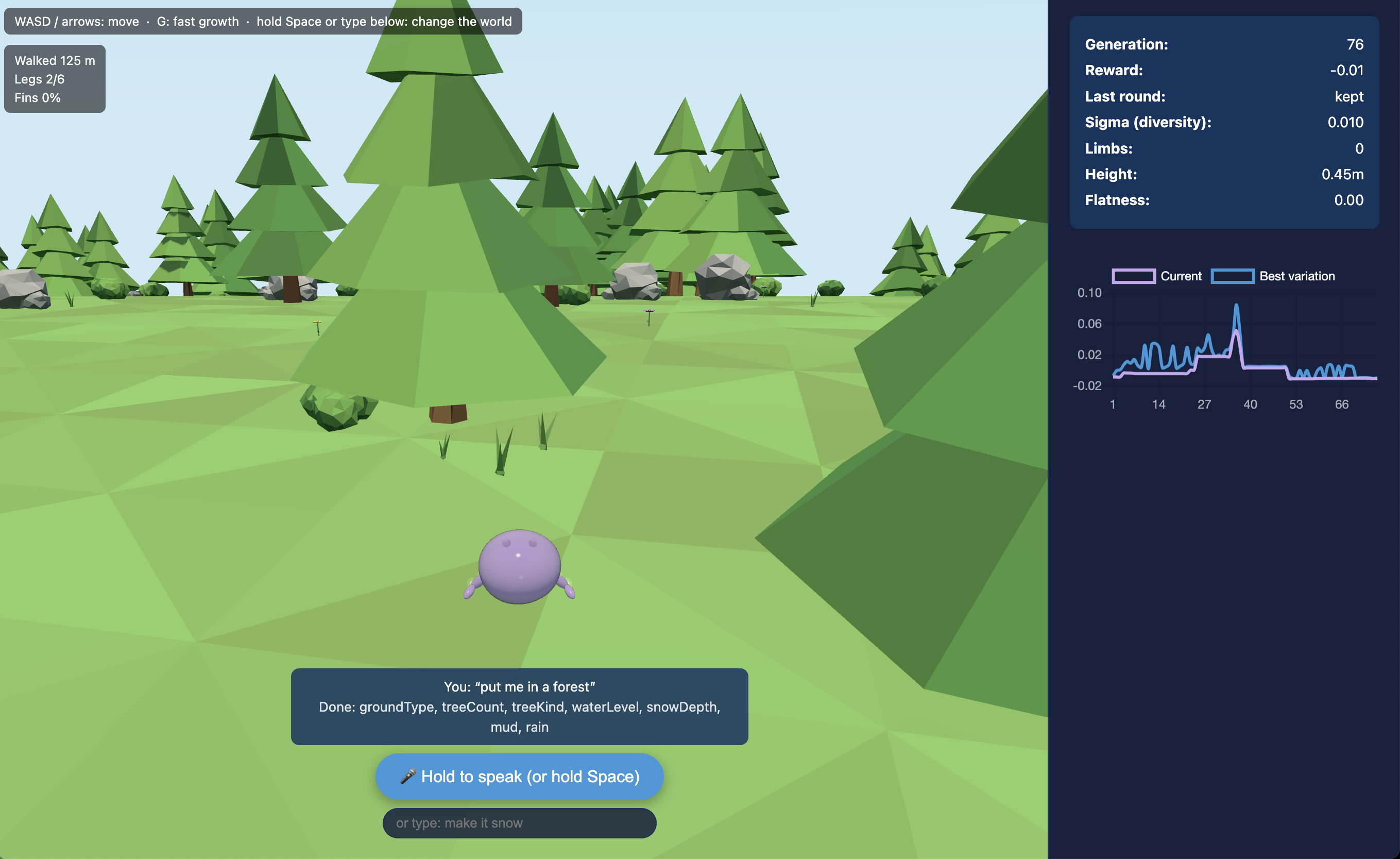
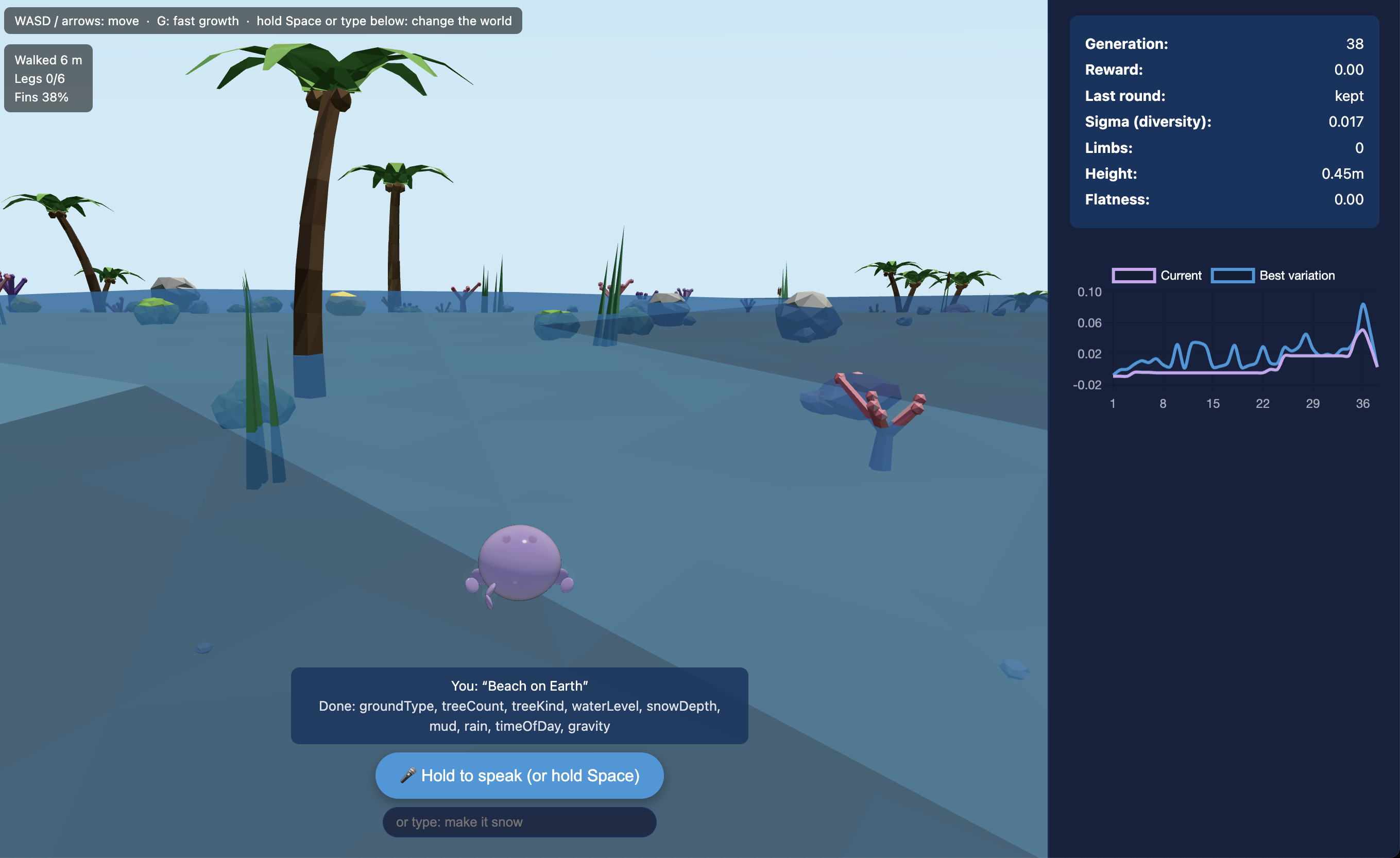
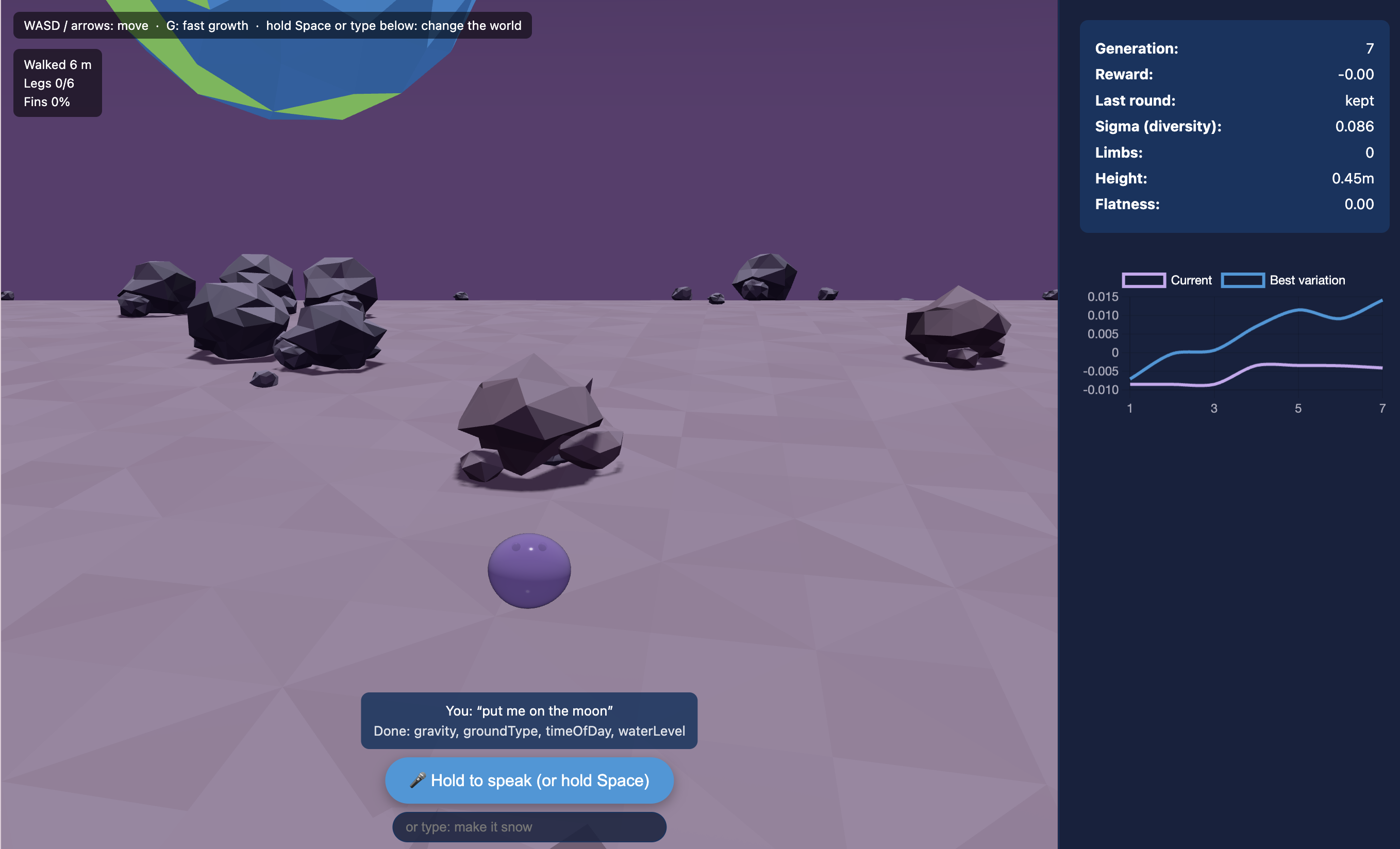
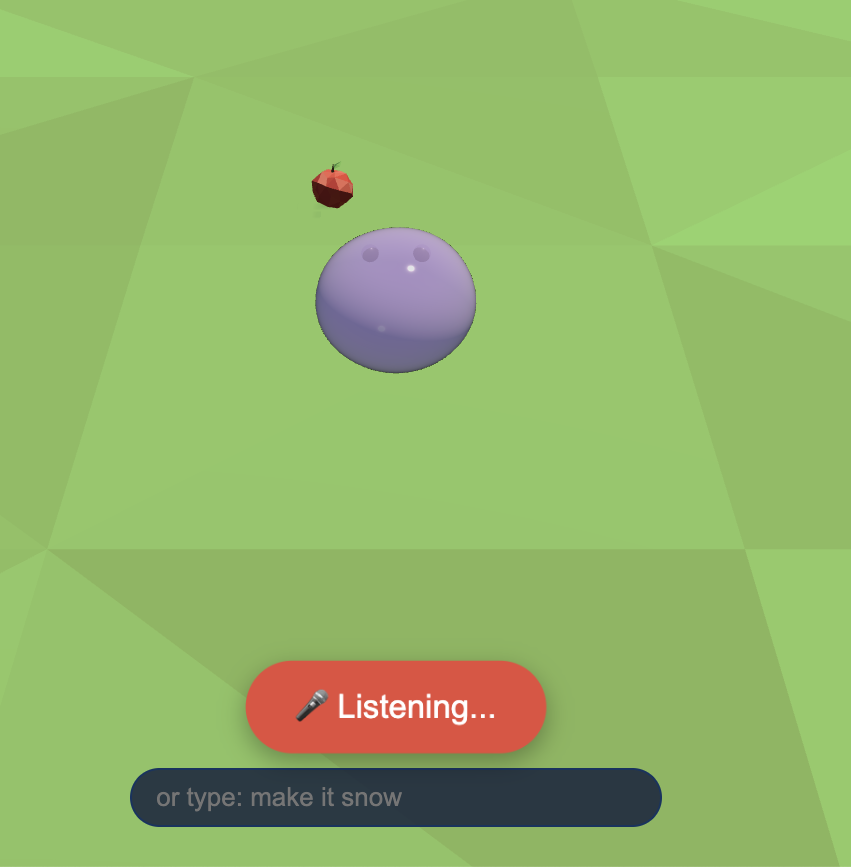
Terrarium lets you watch an agent adapt to a changing world. A single jelly blob lives on a low poly planet, and you speak into a mic (“make it snow,” “add water,” “go to the moon”) to rewrite the physics. The blob grows fins in water, legs on land, tall legs in snow, and hops on the moon. Nobody tells it what to grow, and there are no scores or levels. Under the hood this is a continuous control reinforcement learning problem. The state is 29 inputs such as joint angles, velocities, contacts, and direction to food. The action is target angles for up to 8 joints, and the policy is a small neural network with 616 weights. The reward is fixed in every biome: progress toward food, plus a bonus for eating, minus energy cost, with no reward for body parts. We train with a (1+λ) evolution strategy, a policy search method in the RL family. Every few seconds the blob tests 8 perturbed versions of itself, some with mutated bodies, in hidden Rapier 3D physics rollouts on a CPU. It adopts the best one when it clearly beats the current policy, and a one fifth success rule tunes the noise. The environment keeps changing, so the agent has to relearn its control and redesign its body at the same time. We built it with Devin using five parallel sessions for the physics, blob, learning loop, 3D world, and voice and UI. Each prompt was scoped first with Ask Devin, and every pull request went through Devin Review. A Devin dynamic workflow ran 16 VMs at once to tune the hyperparameters that control learning speed, and more sessions pre evolved seed bodies for five biomes. We used Claude for the physics and 3D work and GPT for the learning loop and voice control.
team Terrarium
- Sweeya Ghanta
- Natasha Narine
submitted Oct 24, 4:56 PM