AAICHA
Helps you have an ai assistant to land deals
what they built
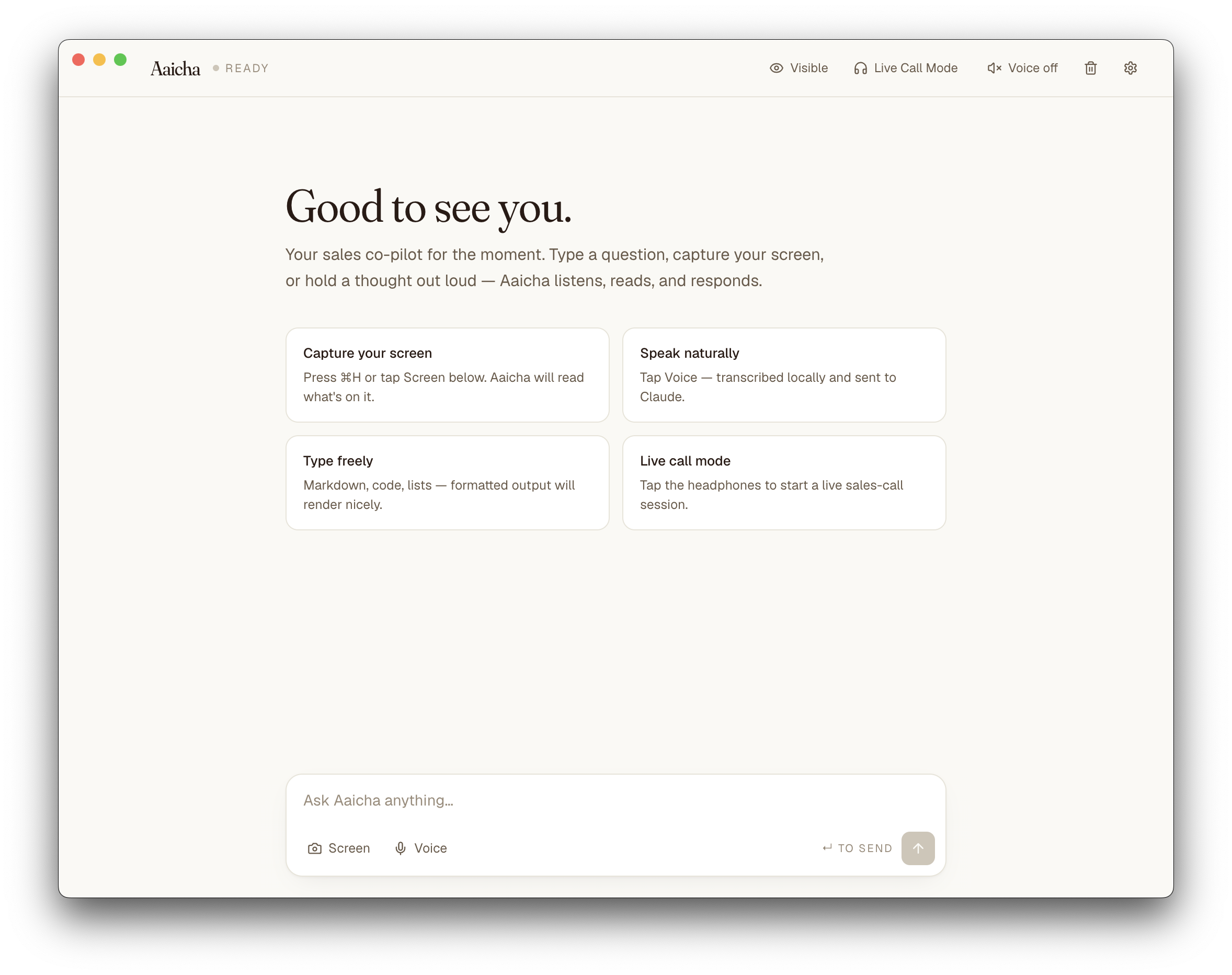
The problem. On a live call, a rep has seconds to answer a pricing question, handle an objection, or ask the right follow-up. Battlecards and playbooks sit in another tab, and nobody can search them mid-sentence. Call-recording tools only help after the call is over. What Aaicha does. - Live transcript: Google Cloud Speech-to-Text streams the conversation into the left pane. - Live coaching: after each finished thought, Claude decides what's happening and responds in the matching format: - Product question: a 1–3 sentence answer drawn from your product docs, with a supporting fact. - Objection: a "Say:" line that acknowledges and reframes, plus a proof point. - Pain or context: the next discovery question to dig deeper. - Buying signal: a concrete next step or close. - Rep talking: short feedback on what worked and what to tighten. - Filler ("um", "okay"): stays silent so it doesn't distract. - Grounded in your product: import a PDF or Word one-pager, pricing sheet, or battlecards. The coach treats it as the source of truth, and when something isn't in the docs it says so instead of making it up. - Call-type modes: Discovery, Demo, Objection Handling, or Closing, each with its own guidance and a framework checklist on the side. - Whisper box: type a private question to the coach mid-call, like "how do I counter the price objection?" - Screen attach: capture what's on screen and the coach factors it into its next suggestion. - Post-call debrief: scores discovery, rapport, objection handling, value, and next steps, then lists strengths and improvements. - Stays off screen shares: a compact overlay window, which can be hidden from screen sharing so the customer never sees it. How it's built. - Electron and React with TypeScript, styled with Tailwind. - Claude Haiku 4.5 handles live coaching, where speed and cost matter. Claude Opus 4.7 handles chat and the debrief, where quality matters more. - Prompt caching on the coaching rules and product docs keeps each turn cheap. - Transcript fragments are batched into one coaching request so the app doesn't call Claude on every sentence. - Speech streams are rotated before Google's 5-minute limit and reconnect automatically with backoff, so a long call doesn't drop. - About 130 unit tests (Vitest) cover the coaching, speech, settings, and app-messaging code. Devin was used to review security, find speech-handling bugs, and identify gaps in the tests.
team Wooper's Warriors
- Siddheya Patade
- Tojoannayu
submitted Oct 24, 4:35 PM