what they built
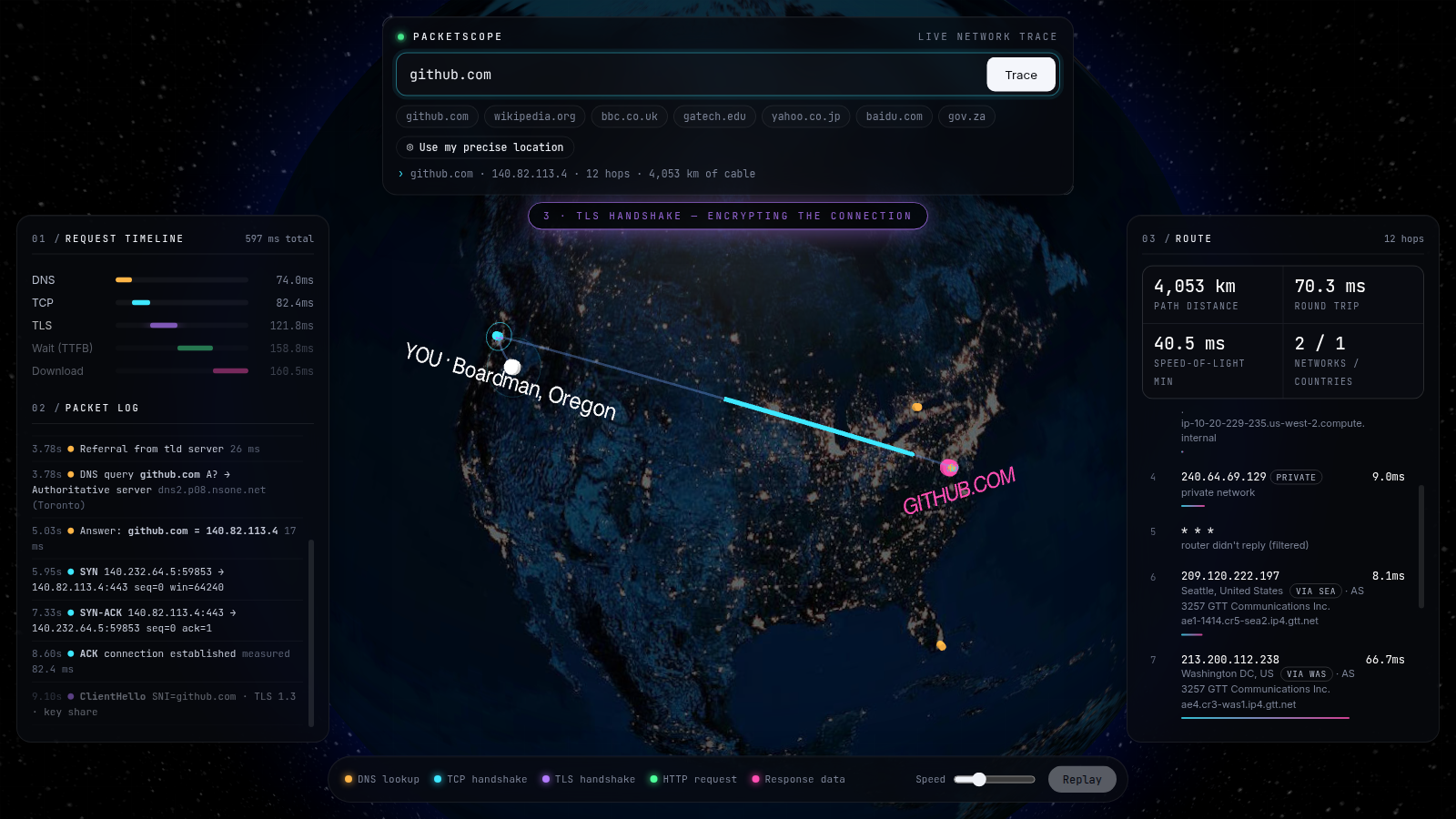
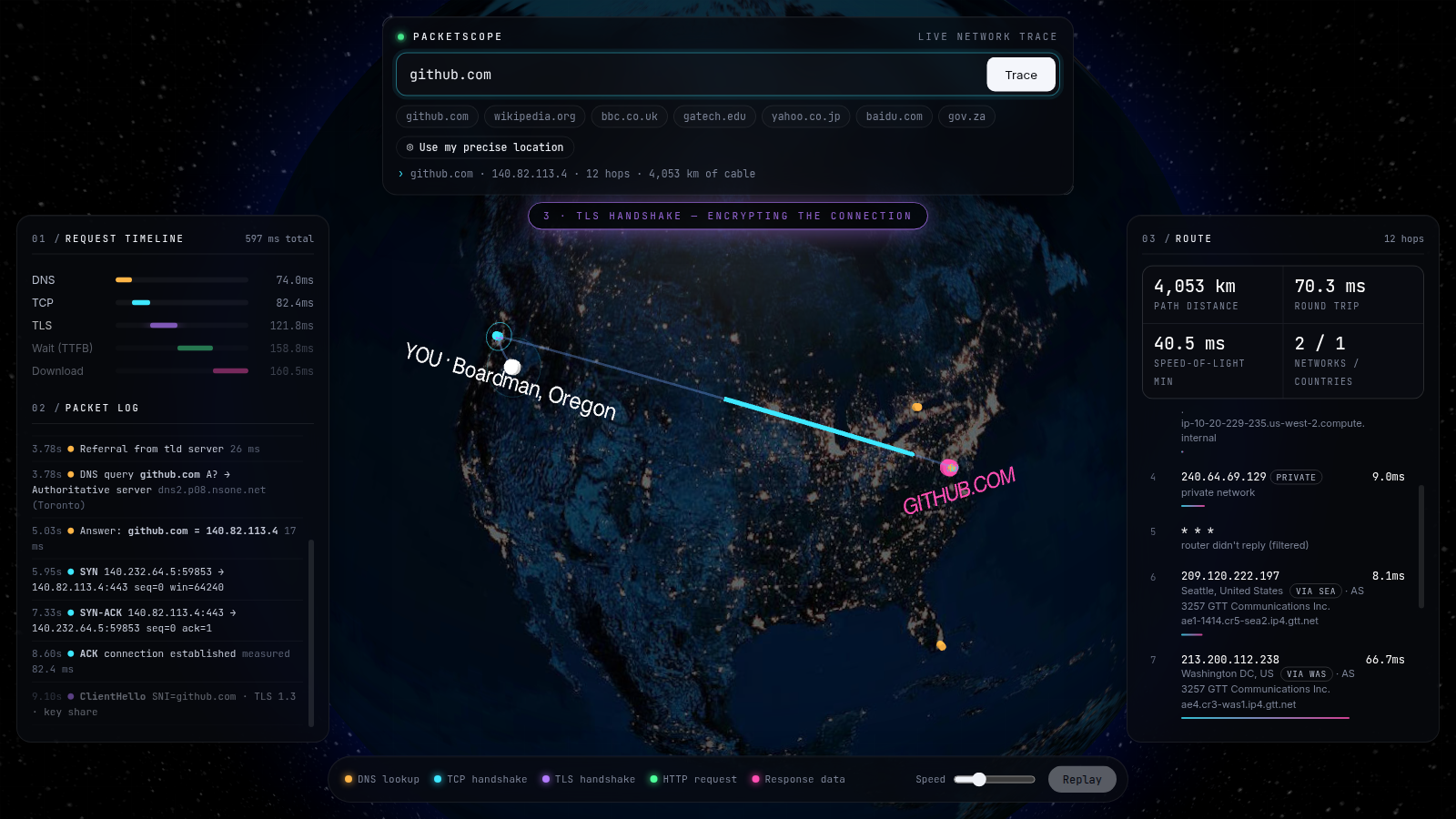
PacketScope turns the invisible part of loading a website into something you can watch. Enter any URL and the backend runs real network measurements: a full DNS trace (root server -> .com server -> the site's own name server), an mtr trace of every router hop, reverse DNS and IP geolocation, and curl timing for TCP, TLS, time to first byte and download. Results stream to the browser as they arrive (server-sent events). A 3D globe then replays the request step by step: the DNS lookup, the TCP SYN/SYN-ACK/ACK, the TLS handshake, the HTTP GET and the response packets each travel hop by hop along the measured route, in their own color, with a timing waterfall, a packet log and a table of hops. What makes it different: a speed-of-light check flags any hop that answered faster than light in fiber could travel from its listed location. That exposes wrong geolocation and labels CDN copy servers as nearby edges (e.g. gatech.edu is answered by a nearby Fastly copy server, not Atlanta). Router hostnames are read for city codes (iad, was1, ashb, 56mar, eqix-dc5) so routers land in the right city. Run locally, it traces from your own network: on the GT wifi you can see the path through campus, the 56 Marietta St SoX hub and Internet2 to Ashburn. It's honest about gaps: routers that don't reply are marked as filtered, and any leg that wasn't measured is drawn as a dashed line. What Devin did: Devin was my whole team. It brainstormed and ranked 13 project ideas against the judging criteria, then built PacketScope end to end: the Python measurement backend, the streaming API and the globe animation. It tested its own work in a browser and fixed bugs like wrong router cities. It set up local mode on my laptop through Devin's local-machine access, installing the tools and debugging why the GT network hid router replies. It also redesigned the UI after studying Godly, Dribbble and Cloudflare Radar. I directed the product decisions; Devin wrote, ran and verified the code. Stack: Python (aiohttp), dig, mtr, curl, ip-api.com geolocation, server-sent events, globe.gl / Three.js, vanilla JS/CSS, no build step.
team Christopher Ling
- Christopher Ling
submitted Oct 24, 4:48 PM